Staffbase wanted to reposition itself beyond an employee communications platform while replacing two retiring lead generation quizzes. The goal was to launch an ROI Calculator that demonstrated measurable business value and generated qualified leads. I designed the end-to-end campaign experience, including the personalized report, ROI whitepaper, paid social, email nurture, and organic content.
Brand
Staffbase
My Role
Senior designer
Year
2026
Softwares


01
Discovery
Every project starts with understanding the problem before thinking about the solution. Since this project involved multiple stakeholders, deliverables, and dependencies, I first sketched out the entire workflow to understand what needed to happen, when it needed to happen, and how each piece connected. Having that roadmap made it much easier to plan the work, manage timelines, and move into design with confidence.


02
Designing the Report
The report became the foundation of the experience. Rather than designing static pages, I created a flexible system that could adapt to different calculation outcomes while maintaining a clear hierarchy.
I designed directly in Claude, generating production-ready HTML alongside the layouts. This allowed engineering to begin implementation immediately while design continued to evolve.


03
Whitepaper
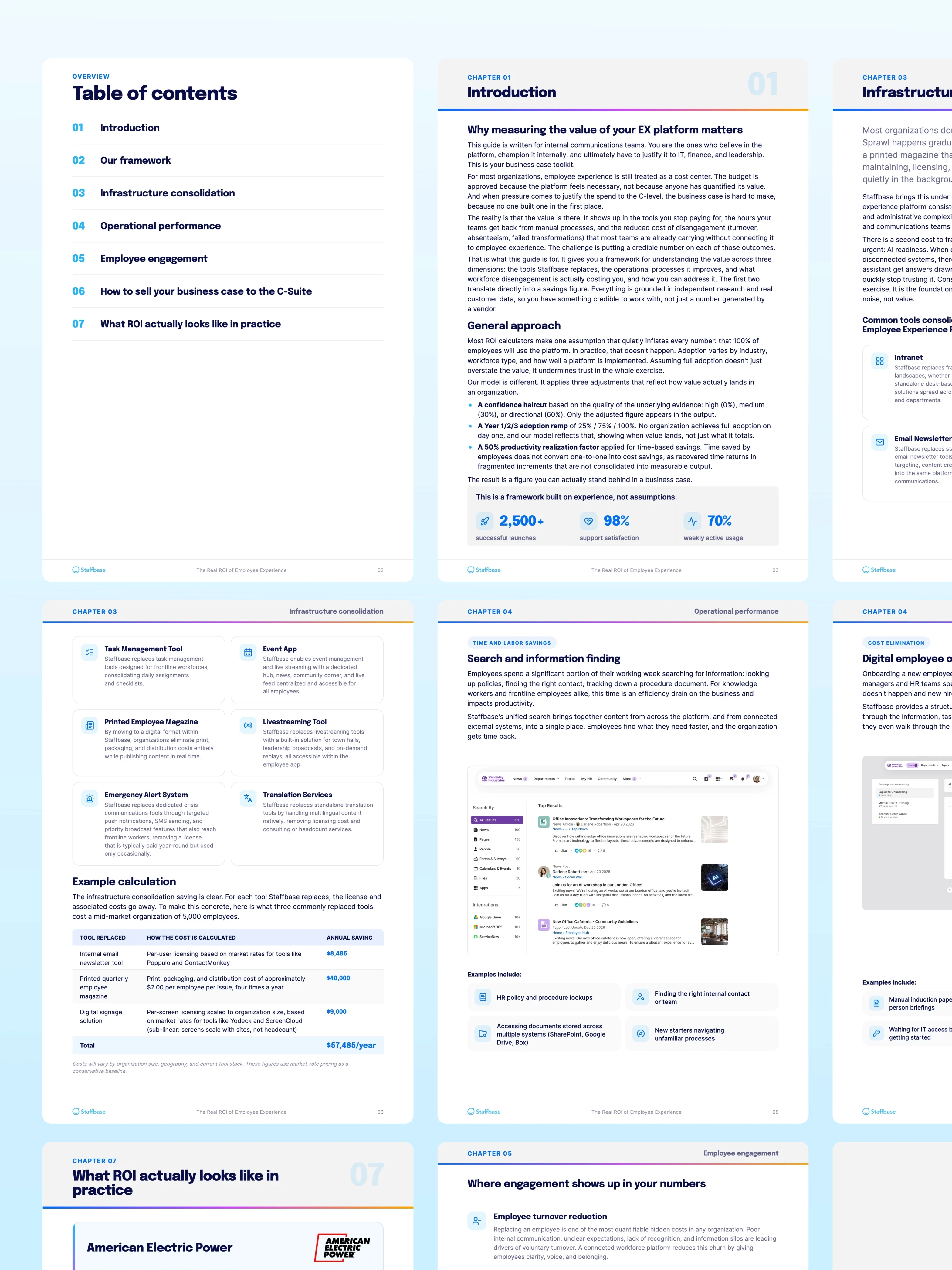
The whitepaper translated the report into a more detailed resource, explaining the methodology behind each calculation. Since content changed frequently, designing directly in Claude made revisions almost instantaneous, allowing stakeholders to refine content without slowing production.
04
Designing the Whitepaper
Rather than designing another standalone document, I treated the whitepaper as an extension of the report. Shared hierarchy, typography, and visual patterns created a familiar reading experience while allowing the content to go much deeper.
Because the content evolved throughout the project, working directly in Claude meant revisions happened in minutes instead of rebuilding layouts. More importantly, conversations shifted away from production and toward improving the quality of the content itself.
05
Developing the Creative Strategy
Regional marketing teams approached me with campaign briefs, but my role extended beyond visual design. I researched competitor campaigns, explored positioning opportunities, and developed messaging directions before creating the first concept.
I found myself spending almost as much time refining headlines as I did refining layouts. Treating copy and design as one creative problem led to stronger campaigns and clearer communication.


06
Campaign Design
With the messaging established, the next challenge was translating strategy into visuals that worked across paid social. Every iteration focused on simplifying information, strengthening hierarchy, and making the value proposition immediately understandable.
Rather than designing isolated assets, I built a flexible creative system that could adapt across formats while maintaining a consistent visual language.


07
Motion Design
As the campaign expanded, our team introduced Jitter for lightweight motion assets. I hadn't used it before, but I saw it as an opportunity to extend the visual language rather than simply animate existing designs.


08
Supporting Content Strategy
As the landing page evolved, the focus shifted from conversion alone to education and discoverability. To support new SEO-driven content, I designed three visual modules that connected Staffbase's product capabilities to its three ROI dimensions.
Each composition was intentionally curated to reinforce the narrative of the section, ensuring the visuals explained the business outcome rather than simply showcasing product features.


09
Campaign Rollout
Once the visual system was established, it was rolled out across paid social, email nurture, organic content, and supporting marketing assets. Although each touchpoint had a different objective, they all shared the same messaging principles and visual foundation.

10
Outcome
The ROI Calculator launched as a global MVP, supported by a personalized report, educational whitepaper, and a multi-channel campaign designed to generate qualified leads and demonstrate measurable business value.
Looking back, this project became much more than a campaign. It fundamentally changed the way I work, marking the point where AI became a natural part of my design process, from research and implementation to creative exploration and iteration.


